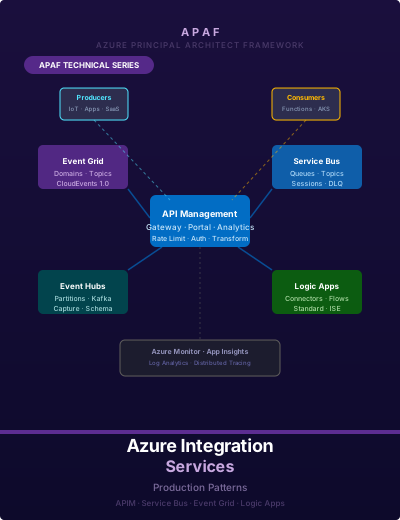
Eleven end-to-end chapters, each with production patterns, worked examples, and lab exercises.
01
Azure Integration Services Architecture Fundamentals
Establishes the architectural vocabulary and service selection framework for the Azure Integration Services portfolio. Covers the four core integration styles and maps each to the appropriate Azure service, then applies Well-Architected Framework pillars as a consistent evaluation rubric.
02
API Management Gateway Design
Covers Azure API Management as the primary API facade layer in production integration architectures. Examines the policy execution pipeline, backend abstractions, and versioning strategies that keep APIs stable, plus rate-limiting to protect backend services from demand spikes.
03
Service Bus Messaging Architecture
Provides a production-grade design guide for Azure Service Bus queue and topic topologies. Examines message sessions for ordered processing, transactions for atomic operations, dead-letter queue handling as a first-class operational concern, and Premium tier geo-replication.
04
Event Grid Event-Driven Patterns
Explores Azure Event Grid as the reactive backbone for loosely coupled service integration. Covers domain-scoped event routing, advanced filtering, the push-to-pull bridge pattern, CloudEvents schema governance, and built-in dead-lettering with retry policies.
05
Event Hubs Real-Time Streaming Platform
Treats Azure Event Hubs as a high-throughput streaming platform for telemetry ingestion, change data capture, and real-time analytics pipelines. Covers partition design, consumer group isolation, the Kafka-compatible surface, Capture, and checkpointing strategies.
06
Logic Apps Workflow Orchestration
Covers Azure Logic Apps Standard as the workflow orchestration engine for multi-step integration processes. Examines stateful vs. stateless selection, connector trade-offs, scope-based error handling with compensation and saga patterns, and long-running human-in-the-loop approval workflows.
07
Hybrid and Multi-Cloud Connectivity
Addresses the connectivity layer for reaching on-premises systems, partner networks, or other clouds. Covers Azure Relay Hybrid Connections, on-premises data gateway clusters, self-hosted APIM gateways, and a complete private endpoint DNS resolution pattern for all integration services.
08
Security and Identity Patterns
Builds a zero-trust security architecture across the integration services portfolio. Covers managed identity federation to eliminate stored credentials, private endpoint topology to remove public network exposure, Key Vault references, and network isolation strategies for locked-down enterprise perimeters.
09
Resilience and Fault Tolerance Design
Designs fault tolerance into every layer of the integration stack. Covers per-service retry and backoff, circuit breaker implementation at the gateway and workflow layers, geo-disaster recovery RTO/RPO planning, and the bulkhead pattern using Service Bus Premium namespaces.
10
Integration DevOps and Testing Strategies
Establishes repeatable deployment and testing pipelines for the integration services estate. Covers Bicep IaC for all integration resources, Logic Apps source control with GitHub Actions, the APIM DevOps Resource Kit, contract testing, and cross-service boundary validation without full production deployments.
11
Monitoring, Observability, and Cost Governance
Operationalizes the integration estate with end-to-end observability and cost accountability. Covers distributed tracing across APIM, Logic Apps, and messaging with Application Insights, Azure Monitor workbooks for integration health dashboards, cost allocation tagging, and performance benchmarking.